

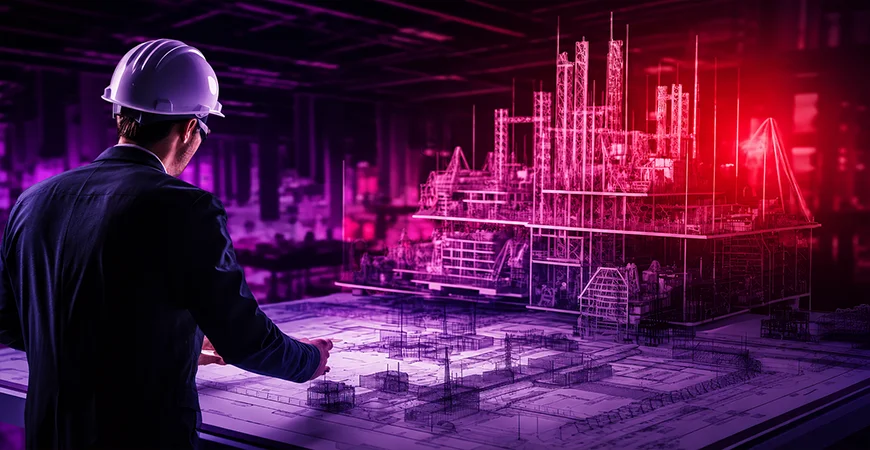
Before Construction & Engineering can become truly intelligent, it first needs to become connected.
Artificial Intelligence is rapidly becoming part of the transformation agenda across Construction & Engineering (C&E). From predictive project controls and intelligent scheduling to document intelligence, computer vision and automated risk detection, the possibilities are significant.
For an industry constantly managing tight margins, complex supply chains, labour constraints and schedule pressures, the interest in AI is understandable. But I believe there is a more fundamental issue that C&E leaders need to address first.
Many organizations are trying to build an AI future on top of a fragmented digital present.
Project teams work in one environment. Finance operates in another. Procurement, contracts, BIM and field operations often have their own systems, spreadsheets and reporting structures. The organization may be generating enormous amounts of data, but that does not necessarily mean it has a connected view of the project.
Trying to build sophisticated intelligence on top of fragmented and inconsistent information is much like building a skyscraper on sand. The technology above may be impressive, but the foundation underneath it is not strong enough.
The Real Challenge Is Connection
A construction project is naturally interconnected. A design revision can change quantities. A quantity change affects procurement. Procurement influences committed costs and potentially the schedule. Schedule changes affect labour and equipment requirements, while contract variations can eventually influence billing, revenue and project margins.
In the physical world, all these events are connected. Digitally, they often are not.
This fragmentation makes it difficult for leadership to develop one reliable view of project performance. More importantly, it limits the context available to AI.
AI cannot compensate for outdated schedules, inconsistent cost classifications, incomplete project histories or disconnected commercial information. If the underlying data cannot be trusted, the intelligence generated from it will always have limitations.
That is why, in my view, AI readiness starts with data readiness.
From Digital Silos to a Connected Digital Thread
For years, digital transformation in C&E has largely focused on digitising individual functions. Organizations implemented scheduling platforms for project controls, ERP systems for finance, procurement solutions for purchasing, BIM platforms for design and mobile applications for field teams.
Each solved an important business problem. But adding more applications does not automatically create a connected enterprise.
The next phase should focus on creating a continuous digital thread across the entire project lifecycle:
[Design & BIM] ──> [Procurement] ──> [Field Operations] ──> [Asset Handover]
└────────────────────────────────────────────────────────────────────────┘ ▲ UNIFIED DIGITAL THREAD ▲
This digital thread should allow project information to flow across functions rather than remain trapped within individual applications. A change originating in design should be capable of informing procurement and field execution, while relevant project and operational information continue through to asset handover.
This does not mean everything needs to happen within one application. It means information should move reliably between systems, supported by common definitions, appropriate governance and trusted data.
Imagine a design revision being understood not simply as a design event, but in terms of its potential impact on quantities, procurement, schedule, project cost and commercial outcomes. That is when digital transformation begins moving from application-level efficiency to enterprise-level intelligence.
Moving From Reporting to Predicting
This connected foundation becomes particularly important when we consider what AI could enable.
Traditional project reporting largely tells us what has already happened: What have we spent? What has been committed? What has been billed? How are we performing against budget?
These questions remain essential. But C&E leadership increasingly needs to understand where the project is heading.
Are early signs of schedule slippage emerging? Is a procurement delay likely to affect the critical path? Is the Estimate at Completion moving in the wrong direction? Which projects are beginning to show margin pressure? Where should management intervene today?
AI can potentially help answer these questions by identifying patterns across historical and current project information.
But predictive intelligence becomes meaningful only when schedule, cost, procurement, contracts, field and financial information can be understood together.
Technology Is Only Part of the Foundation
Platforms such as Oracle Primavera, Oracle Aconex and Oracle Fusion Cloud can play an important role in creating this connected environment for project-driven organizations.
But implementing technology alone does not create transformation.
A world-class project platform implemented in isolation can simply become another silo. The real value comes from connecting project planning and controls with collaboration, procurement, contracts, field operations and enterprise financial processes.
This is why C&E domain understanding matters as much as technology expertise.
Instead of asking only, “How do we implement this platform?”, organizations should ask, “How should information move through our business so that everyone is working from a trusted project picture?”
That changes the transformation conversation completely.
What a Connected Foundation Can Unlock
Once that foundation exists, AI becomes far more interesting.
AI could continuously analyse project information to identify emerging cost and schedule risks before they appear in conventional reporting. It could connect procurement schedules with project plans and supplier information to provide earlier warning of potential supply-chain disruptions.
There is also a significant opportunity around institutional knowledge.
Every project generates RFIs, change orders, correspondence, decisions and lessons learned. Much of this knowledge becomes buried once the project closes.
A connected digital environment creates the possibility for AI to turn years of project history into searchable organizational intelligence-helping teams understand where similar problems occurred before, how they were addressed and what the outcome was.
That, to me, is where AI moves beyond automation and starts becoming genuinely valuable.
AI Readiness Is a Leadership Decision
I don’t believe AI readiness is simply an IT initiative. It is a leadership issue.
Organizations need to decide how project information should be structured, which processes should be standardized, how data should be governed and how systems should interact.
My view of the transformation journey is simple:
Connect → Standardise → Govern → Automate → Apply Intelligence
There is a reason intelligence comes last.
Organizations cannot intelligently automate processes they have not standardized, and leaders cannot confidently trust AI-generated recommendations if they do not trust the information underneath them.
As AI technology becomes increasingly accessible, the competitive advantage may not ultimately come from having the most sophisticated model. It may come from having the best business context feeding that model.
So before C&E leaders ask, “Which AI solution should we implement?”, I believe there is a more important question:
“Are we building the digital foundation that will allow AI to understand our business?”
The organizations that lead the next phase of Construction & Engineering transformation may not be those that adopt AI first. They may be the ones that build the strongest foundation for it.
Because before C&E can become truly intelligent, it first needs to become connected.
Prashant Singh
Managing Partner, ShiftPurple
About ShiftPurple
ShiftPurple works with Construction & Engineering and project-driven organizations on enterprise transformation across Oracle Cloud and C&E technologies. We help organizations connect project, operational and financial processes to create scalable digital foundations for more integrated, data-driven and intelligent operations.